If you’ve ever worked with aerospace components, medical implants, or high-performance marine machinery, you’ve probably encountered titanium plates—they’re the unsung workhorses that hold some of the most critical parts of our modern world together. As a titanium plates supplier who’s spent 12 years sourcing, testing, and delivering these materials to engineers and manufacturers across 17 countries, the question I get asked most often isn’t about price or lead times—it’s about creep resistance. People want to know: how well do these plates hold up under constant, long-term stress at high temperatures? And more importantly, how does that performance matter for the parts we build with them? Titanium Plates

Let’s start by defining creep, because if you’re not a materials scientist, the term might sound like something out of a horror movie. Creep is the gradual, time-dependent deformation of a material under a sustained load. Think of it like leaving a heavy book pressing down on a rubber band for months—over time, the rubber band will stretch out, even if the force never changes. For metals like titanium, creep only becomes a major concern at temperatures above a certain threshold, right around 50% of their melting point in Celsius. For pure titanium, that temperature is roughly 480°C, and for common titanium alloys we supply—like Ti-6Al-4V, the workhorse of the industry—it’s a bit higher, around 520°C. That means if you’re using titanium plates in applications that operate below these temps, you probably won’t have to worry about creep at all. But push them past that threshold, and the creep behavior gets fascinating (and, if you’re not prepared, problematic).
I’ve seen this play out firsthand. A customer of mine a few years back was making exhaust valves for a high-performance race car, and they’d initially specified stainless steel plates for the valve retainers. The first track test went great, but after 20 hours of racing, some of the retainers had deformed so much that the valves wouldn’t seat properly—engine failure. When they switched to Ti-6Al-4V titanium plates, the problem vanished. Why? Because at the operating temperature of those retainers (around 450°C, right at the edge of stainless steel’s creep threshold), titanium’s atomic structure and alloying elements slow down the creep process dramatically. That’s not to say titanium doesn’t creep—nothing is immune to creep—it’s just far more resistant to it than most other common metals at elevated temperatures.
Let’s dive into the science a bit, because it’s what sets titanium plates apart from other materials. Creep in metals happens in three stages: primary, secondary, and tertiary. Primary creep is the initial fast deformation, where the material starts to “flow” under load. Secondary creep is the steady, slow rate of deformation that’s the longest phase, and it’s the one we care about most for long-term performance. Tertiary creep is the final acceleration before failure, when small cracks start to form and the material weakens. Titanium’s crystal structure is hexagonal close-packed (HCP), which is less ductile than the body-centered cubic (BCC) structure of steel or the face-centered cubic (FCC) of aluminum, but when you add alloying elements like aluminum, vanadium, or molybdenum, you tailor its ability to resist creep. For example, Ti-6Al-4V gets its creep resistance from the way aluminum atoms align with titanium’s lattice, making it harder for dislocations (the tiny atomic-level slips that cause deformation) to move. Vanadium, on the other hand, improves the alloy’s ductility, so even if some deformation does occur, the plate doesn’t crack prematurely.
Another alloy we supply, Ti-6Al-2Sn-4Zr-2Mo (often called Ti-6242), is specifically engineered for high-temperature applications. It’s got a higher creep resistance than Ti-6Al-4V, making it ideal for gas turbine blades, heat exchangers, and nuclear reactor components, where operating temperatures can hit 600°C. I’ve had a power generation client use Ti-6242 plates for their boiler tubes, and they reported that after 5 years of continuous operation, the creep rate was less than 0.001% per hour— that’s almost unheard of for a metal that’s half the weight of steel. To put that in perspective, if a 1-meter long Ti-6242 plate were loaded at a constant stress at 600°C, it would only stretch 0.08 millimeters over 10 years. That’s the kind of reliability that makes titanium plates worth the investment, even if they cost a bit more upfront than steel or aluminum.
But here’s the thing: creep resistance isn’t just about the alloy. It’s also about the quality of the plate itself. As a supplier, I can tell you that not all titanium plates are created equal. We source our plates from mills that use vacuum arc remelting (VAR) to refine the titanium, which removes impurities like oxygen, nitrogen, and hydrogen—elements that drastically increase creep rate by making the material more brittle. I’ve seen cheap, unrefined titanium plates from overseas suppliers that failed creep tests at 400°C, while our VAR-processed plates meet or exceed ASTM B265 standards, which specify the requirements for titanium and titanium alloy plates. That’s why we test every batch we send out: we run creep tests at 550°C for 1000 hours under a fixed load, and we track the deformation rate to make sure it stays below 0.005% per hour. For our high-temperature grade plates, that number is even lower.
I also get asked a lot about how creep interacts with other factors, like stress and environment. Titanium’s creep resistance holds up well in most environments, but if you’re dealing with corrosive substances—like saltwater in marine applications, or acids in chemical processing—you have to consider corrosion creep, which is when corrosion and creep work together to speed up deformation. For example, a titanium plate used in a offshore oil rig’s riser will experience both constant tension from the weight of the pipe and saltwater corrosion, which can create tiny pits in the plate that act as stress raisers, making it easier for creep to start. That’s why we work with our customers to match the right alloy to their specific environment: for marine applications, we often recommend Ti-3Al-2.5V, which has good corrosion resistance and solid creep performance at lower temperatures (up to 400°C), whereas for high-heat, low-corrosion environments, Ti-6242 is the better choice.
Let’s talk about a real-world example that’s closer to home, for me. A medical device manufacturer reached out a couple years ago, needing titanium plates for spinal fusion implants. The plates had to support a patient’s full weight for decades, operating at body temperature (37°C). At that temperature, pure titanium’s creep rate is practically zero—less than 0.000001% per hour. So even if a patient lives 80 years, the plate would stretch less than a thousandth of a millimeter. That’s why titanium is the gold standard for orthopedic implants; it doesn’t deform over time, so the implant stays in place, and there’s no risk of it shifting or causing pain. The customer had initially considered stainless steel, but they were worried about creep, and after we ran a test on our Ti-6Al-4V plates, they switched, and they’ve been a repeat customer ever since.
Of course, no material is perfect, and titanium plates do have their limits when it comes to creep. If you load a titanium plate beyond its ultimate tensile strength, creep will happen much faster, regardless of temperature. And at temperatures above 600°C, even the best titanium alloys start to lose their creep resistance, because the atomic motion becomes so fast that the alloying elements can no longer pin dislocations effectively. In those cases, we usually recommend superalloys like Inconel, but for 90% of the high-stress, high-temperature applications our customers are dealing with—from automotive parts to aerospace components to industrial machinery—titanium plates outperform almost every other material on the market when it comes to creep resistance.
As a supplier, my job isn’t just to send you a plate that fits your specs. It’s to help you understand how that plate will perform over the life of your product. I’ve had customers come to me thinking titanium is too expensive, but when I show them the creep data—how their part will last 20 years instead of 5 years because of the plate’s resistance to deformation—they see the value. I’ve also had customers who tried to cut corners by buying lower-grade plates, only to come back when their product failed prematurely, costing them thousands in warranty repairs and lost reputation.
So if you’re working on a project where reliability over time is non-negotiable, if you’re dealing with high temperatures or constant loads, don’t just ask “what’s the price of titanium plates.” Ask about their creep resistance. Ask about the alloy, the refinement process, the test data. As someone who’s been in this industry long enough to see parts fail because of bad material choices, I can tell you that investing in high-quality titanium plates with proven creep resistance is one of the best decisions you can make for your project.
If you’re ready to talk about your specific application, if you need creep test data for a batch of plates, or if you want to compare titanium to other materials for your project, don’t hesitate to reach out. We work with customers across industries, from small startups to large multinational corporations, and we’re here to help you find the right titanium plates for your needs. Let’s build something reliable that will last for decades—together.
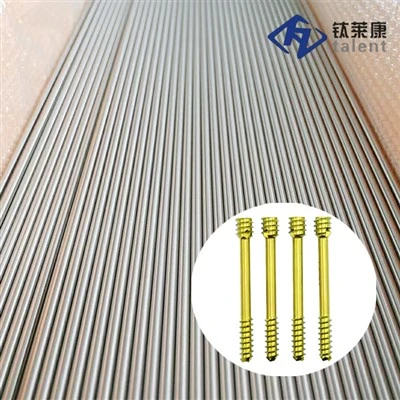
Medical Titanium Wires References:
- Metals Handbook: Volume 13, Corrosion, 10th Edition, ASM International, 1987.
- Boyer, R. R., An Overview on the Use of Titanium in the Aerospace Industry, Materials Science and Engineering: A, Vol. 213, No. 1-2, 1996, pp. 103-114.
- Lowe, T. C., and V. K. Vedula, Creep Behavior of Titanium Alloys for High-Temperature Applications, Titanium Alloys: Toward Improved Performance, ASTM International, 2000, pp. 239-255.
- ASTM Standard B265, Standard Specification for Titanium and Titanium Alloy Strip, Sheet, and Plate, ASTM International, 2022.
- Furman, A. I., Titanium Alloys in Structural Applications, CRC Press, 2011.
Baoji Tailaikang High-Tech Metal Materials Co., Ltd.
With abundant experience, we are one of the most professional titanium plates manufacturers and suppliers in China. Please feel free to buy titanium plates for sale here and get pricelist from our factory. For price consultation, contact us.
Address: No. 1, Southeast Cross of Gaoxin Avenue and Fenghuang 3rd Road, High-tech Development Zone, Baoji City, Shaanxi Province, China
E-mail: sale@tlkjs.com
WebSite: https://www.tlkmetal.com/
